Skip to content
MyBodyAI
LEARN
Topic Guides Blog Glossary Tools
DEVICES
Compare all devices Supported devices
Products Pricing FAQ About MyBodyAI

Pasting Your Watch Data Into ChatGPT? Here Is What It Misses

Exporting your health data and asking a chatbot to explain it is a smart instinct. But a general-purpose AI is blind to the three things that decide whether the answer is any good.

Published 2026-07-24 9 min read AI & Health
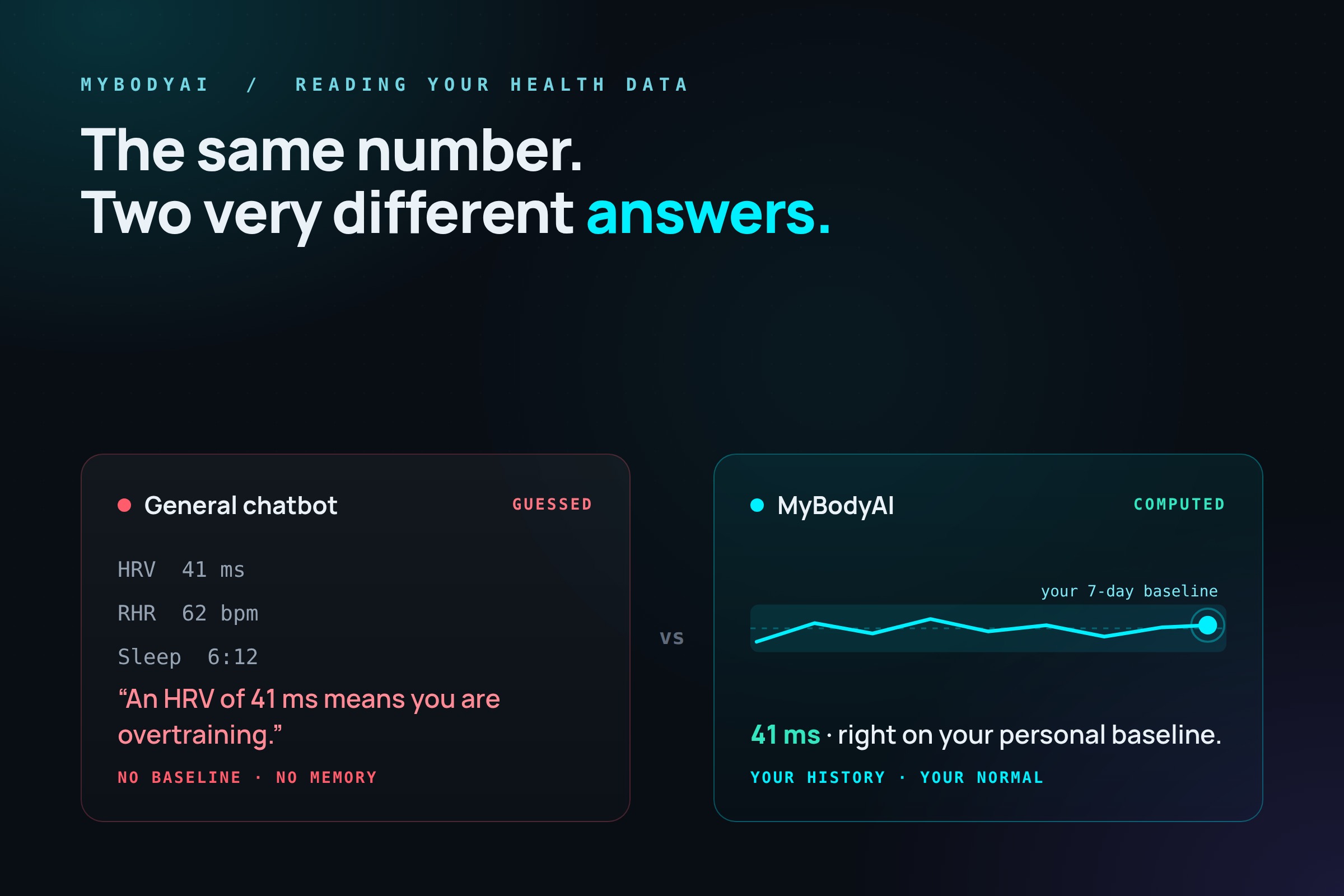
Raw health data pasted into a chat window versus a continuous personal baseline

Why so many people paste their health data into a chatbot

Modern wearables are extraordinary at collecting and hopeless at explaining. Your Garmin, Fitbit, Polar or Withings records heart rate variability, resting heart rate, sleep stages, respiration, skin temperature and a dozen other signals every single night. Then the app shows you one number for today and a small graph, and quietly leaves the interpretation to you.

So people do the obvious thing. They export the data, open ChatGPT or another chatbot, paste in a wall of numbers, and ask the human question: is this good? should I be worried? am I overtraining? It is a completely reasonable instinct. You have the raw material, you want meaning, and a chatbot will happily produce a confident, well-written paragraph in seconds.

The problem is not the instinct. The problem is that a general-purpose AI is missing the three things that decide whether that paragraph is actually true for you.

1. It has never met you, so it has no baseline

Almost nothing in health data means anything on its own. A resting heart rate of 58 is excellent for one person and a warning sign for another. An HRV reading is only useful compared to your own recent average, not to a figure from a textbook. The single most important question in physiology is not what is this value? but what is this value for you, compared to your normal?

A one-shot paste into a chatbot has no answer to that. It sees a snapshot with no past. At best it compares your numbers to population averages, which flatten exactly the individual differences that make the data worth reading. At worst it has nothing to compare against at all and simply guesses which side of "normal" you land on.

This is why a morning HRV that has dropped below your personal seven-day baseline is a meaningful signal, while the same absolute number on someone else might mean nothing. Without your history, the interpretation is a coin flip dressed up as expertise.

2. When it does not know, it makes something up

A language model does not look your answer up. It predicts the next most plausible words. Most of the time that produces something reasonable, which is exactly what makes the failures dangerous: the wrong answer arrives in the same calm, authoritative voice as the right one.

This is not a rare edge case. When physicians tested general chatbots on real patient questions, a meaningful share of the answers were problematic and a smaller but real fraction were outright unsafe (npj Digital Medicine, 2026). A separate line of research on healthcare queries documented the same pattern of confident fabrication, now measured carefully enough that it has its own benchmarks (MedHalu, 2024).

In most contexts a confident wrong answer is merely annoying. In health it is worse than useless, because you have no way to tell it apart from a correct one. A made-up threshold such as "an HRV under 40 means overtraining" sounds identical to a real one, and you will act on both.

The core issue: a chatbot cannot signal the difference between an answer it knows and an answer it invented. Both come out fluent and self-assured. With your body, that gap is the whole ballgame.

3. Your most private data just left the building

The moment you paste months of biometric data into a third-party chatbot, that data is sitting on someone else's servers. Depending on the service and its settings, it may be retained, reviewed by humans, or used to train future models. Health data is the most sensitive category there is, and "I pasted it into a chat box" is not a privacy model.

The deeper problem: it forgets you the moment you close the tab

Even if a chatbot answered perfectly today, tomorrow it starts from zero. Health is not a snapshot, it is a trajectory. The interesting questions are longitudinal: is your recovery trending down over three weeks? Did your resting heart rate creep up for four days before you felt the cold coming on? Is your sleep debt quietly accumulating? None of that survives a fresh chat window. A conversation has no memory of your body.

What actually reading your health data takes

This is the gap MyBodyAI is built to close, and it is worth being precise about how, because the honest version is more convincing than the hype.

The numbers are computed, not narrated. The scores you see are produced by deterministic code with a single source of truth on the server, not by a text generator improvising. The same inputs always give the same output, and every result is stamped with the exact version of the maths that produced it. There is no room to "hallucinate" a value, because no value is ever guessed.

It is built on your baseline, across devices. Your history is stitched together from every provider you connect, Garmin, Fitbit, Polar and Withings, into one continuous timeline. Switch watches and you keep your past. Every signal is then read against your own rolling average, so "good" and "bad" mean good and bad for you.

It respects the difference between how you feel and what was measured. Instead of overriding your own report with a device number, or ignoring the device because you feel fine, it compares the two and tells you when they disagree, which is often the most useful signal of all.

It is honest about what it does not know. Modelled estimates are labelled as estimates, not dressed up as measurements. When there is not enough data, it says so, rather than inventing a reassuring verdict.

Your data stays yours. It lives in your own isolated store, connection tokens are encrypted, and you can export or permanently delete everything at any time. You can read exactly how in the privacy policy.

Learn more: see how MyBodyAI reads HRV and turns it into a plain-language Body Status, or how wearables can flag an illness before you feel it.

So should you stop using AI to understand your body? Not at all

Using AI to make sense of your health data is the right idea. It is genuinely one of the best things this technology can do. It simply cannot be done well by a chat window that meets you fresh every time, guesses when it is unsure, and hands your data to a stranger.

Done properly, the AI needs a memory of you, deterministic maths underneath the language, and the discipline to admit uncertainty instead of papering over it. That is the whole difference between pasting your numbers into a chatbot and having a system that actually knows your body, night after night. If you have ever exported your data to ask an AI whether you are okay, you already understand the problem MyBodyAI exists to solve.

References

  • Large language models provide unsafe answers to patient-posed medical questions. npj Digital Medicine (2026). Article s41746-026-02428-5.
  • Agarwal S et al. MedHalu: Hallucinations in Responses to Healthcare Queries by Large Language Models. arXiv (2024). arXiv:2409.19492.

Proč tolik lidí sype svá zdravotní data do chatbota

Moderní chytré hodinky jsou skvělé ve sbírání dat a beznadějné ve vysvětlování. Váš Garmin, Fitbit, Polar nebo Withings každou noc změří variabilitu srdeční frekvence, klidový tep, fáze spánku, dýchání, kožní teplotu a další desítku signálů. Pak vám aplikace ukáže jedno číslo za dnešek a malý graf, a výklad potichu nechá na vás.

Lidé proto udělají to nasnadě. Vyexportují data, otevřou ChatGPT nebo jiného chatbota, vloží do něj hromadu čísel a zeptají se úplně lidsky: je to dobré? mám se bát? nepřetrénovávám se? Je to naprosto pochopitelný nápad. Máte surovinu, chcete význam, a chatbot vám během pár vteřin ochotně napíše sebejistý, dobře znějící odstavec.

Potíž není v tom nápadu. Potíž je, že obecné umělé inteligenci chybí tři věci, které rozhodují, jestli je ten odstavec pro vás vůbec pravdivý.

1. Nikdy vás nepotkala, takže nezná vaši normu

Skoro nic ve zdravotních datech nedává smysl samo o sobě. Klidový tep 58 je u jednoho člověka výborný a u druhého varovný. Hodnota HRV má cenu jedině ve srovnání s vaším vlastním nedávným průměrem, ne s číslem z učebnice. Nejdůležitější otázka ve fyziologii nezní jaká je ta hodnota?, ale jaká je ta hodnota u vás oproti vašemu normálu?

Jednorázové vložení do chatbota na tohle odpověď nemá. Vidí snímek bez minulosti. V lepším případě srovná vaše čísla s průměrem populace, čímž zahladí přesně ty individuální rozdíly, kvůli kterým má smysl data vůbec číst. V horším případě nemá s čím srovnávat a prostě hádá, na které straně „normálu" jste.

Proto ranní HRV, které spadlo pod váš osobní sedmidenní průměr, je smysluplný signál, zatímco stejné absolutní číslo u někoho jiného nemusí znamenat nic. Bez vaší historie je výklad hod mincí převlečený za odbornost.

2. Když neví, něco si vymyslí

Jazykový model si odpověď nikde nedohledá. Předpovídá nejpravděpodobnější další slova. Většinou z toho vyjde něco rozumného, a právě to dělá jeho selhání zákeřným: špatná odpověď přijde stejně klidným a sebejistým hlasem jako ta správná.

Není to vzácná výjimka. Když lékaři testovali obecné chatboty na skutečných otázkách pacientů, znatelná část odpovědí byla problematická a menší, ale reálný podíl přímo nebezpečný (npj Digital Medicine, 2026). Samostatný výzkum zdravotních dotazů popsal tentýž vzorec sebejistého vymýšlení, dnes změřený tak pečlivě, že na něj existují vlastní testovací sady (MedHalu, 2024).

Ve většině situací je sebevědomě špatná odpověď jen otravná. U zdraví je horší než k ničemu, protože ji nemáte jak odlišit od té správné. Vymyšlená hranice jako „HRV pod 40 znamená přetrénování" zní úplně stejně jako skutečná, a vy se zařídíte podle obou.

Jádro problému: chatbot neumí naznačit rozdíl mezi odpovědí, kterou zná, a odpovědí, kterou si vymyslel. Obě znějí plynule a sebejistě. A právě v ten rozdíl jde u vašeho těla úplně o všechno.

3. Vaše nejsoukromější data právě odešla ven

Ve chvíli, kdy vložíte měsíce biometrických dat do cizího chatbota, jsou ta data na cizích serverech. Podle konkrétní služby a jejího nastavení se mohou ukládat, číst je mohou lidé nebo mohou posloužit k trénování dalších modelů. Zdravotní data jsou ta nejcitlivější kategorie vůbec, a „vložil jsem to do chatu" žádná ochrana soukromí není.

Hlubší problém: zapomene vás, jakmile zavřete okno

I kdyby vám chatbot dnes odpověděl dokonale, zítra začíná od nuly. Zdraví není snímek, je to vývoj. Zajímavé otázky jsou dlouhodobé: klesá vám zotavení tři týdny v řadě? Zvýšil se vám klidový tep čtyři dny předtím, než jste ucítili blížící se nachlazení? Nenačítá se vám potichu spánkový dluh? Nic z toho nepřežije nové okno chatu. Konverzace nemá o vašem těle žádnou paměť.

Co doopravdy obnáší přečíst vaše zdravotní data

Přesně tuhle mezeru má MyBodyAI zaplnit, a stojí za to říct přesně jak, protože poctivá verze je přesvědčivější než velká slova.

Čísla se počítají, ne vyprávějí. Skóre, která vidíte, vytváří deterministický kód s jediným zdrojem pravdy na serveru, ne generátor textu, který improvizuje. Stejné vstupy dají vždy stejný výsledek a u každého výsledku je razítko s přesnou verzí výpočtu, který ho vytvořil. Není kde „halucinovat" hodnotu, protože se žádná hodnota nikdy nehádá.

Stojí na vaší normě, napříč zařízeními. Vaše historie se skládá ze všech providerů, které připojíte, tedy z Garminu, Fitbitu, Polaru a Withings, do jedné souvislé časové osy. Vyměníte hodinky a minulost vám zůstane. Každý signál se pak čte proti vašemu vlastnímu klouzavému průměru, takže „dobré" a „špatné" znamená dobré a špatné pro vás.

Respektuje rozdíl mezi tím, jak se cítíte, a tím, co se změřilo. Místo aby přebilo váš vlastní pocit číslem z hodinek, nebo naopak hodinky ignorovalo, protože se cítíte dobře, ty dvě věci porovná a řekne vám, když si odporují, což bývá ze všech signálů ten úplně nejužitečnější.

Je poctivé v tom, co neví. Modelované odhady jsou označené jako odhady, ne vydávané za měření. Když není dost dat, řekne to, místo aby si vymyslelo uklidňující verdikt.

Vaše data zůstávají vaše. Leží ve vašem vlastním odděleném úložišti, přístupové tokeny jsou šifrované a všechno můžete kdykoli vyexportovat nebo natrvalo smazat. Jak přesně, si můžete přečíst v zásadách ochrany soukromí.

Více k tématu: podívejte se, jak MyBodyAI čte HRV a převádí ho na srozumitelný Body Status, nebo jak hodinky umí upozornit na nemoc dřív, než ji ucítíte.

Máte tedy přestat používat AI k pochopení svého těla? Vůbec ne

Nechat si od AI přečíst zdravotní data je správný nápad. Je to opravdu jedna z nejlepších věcí, které tahle technologie umí. Jen se to nedá dělat dobře v okně chatu, které vás pokaždé potkává poprvé, hádá, když si není jisté, a vaše data předá cizímu člověku.

Když se to udělá pořádně, potřebuje AI paměť na vás, deterministický výpočet pod jazykem a kázeň přiznat nejistotu, místo aby ji zamluvila. To je celý rozdíl mezi vložením čísel do chatbota a systémem, který vaše tělo doopravdy zná, noc po noci. Pokud jste někdy exportovali data, abyste se AI zeptali, jestli jste v pořádku, už teď rozumíte problému, kvůli kterému MyBodyAI vzniklo.

Reference

  • Large language models provide unsafe answers to patient-posed medical questions. npj Digital Medicine (2026). Článek s41746-026-02428-5.
  • Agarwal S et al. MedHalu: Hallucinations in Responses to Healthcare Queries by Large Language Models. arXiv (2024). arXiv:2409.19492.

Found this useful? Share it.