

Amazfit Bip 6: the $79.99 watch worth a second look
A budget Zepp OS smartwatch that quietly competes with watches at two to three times the price. Here is what it does well, what it leaves out, and who should put it on the shortlist.
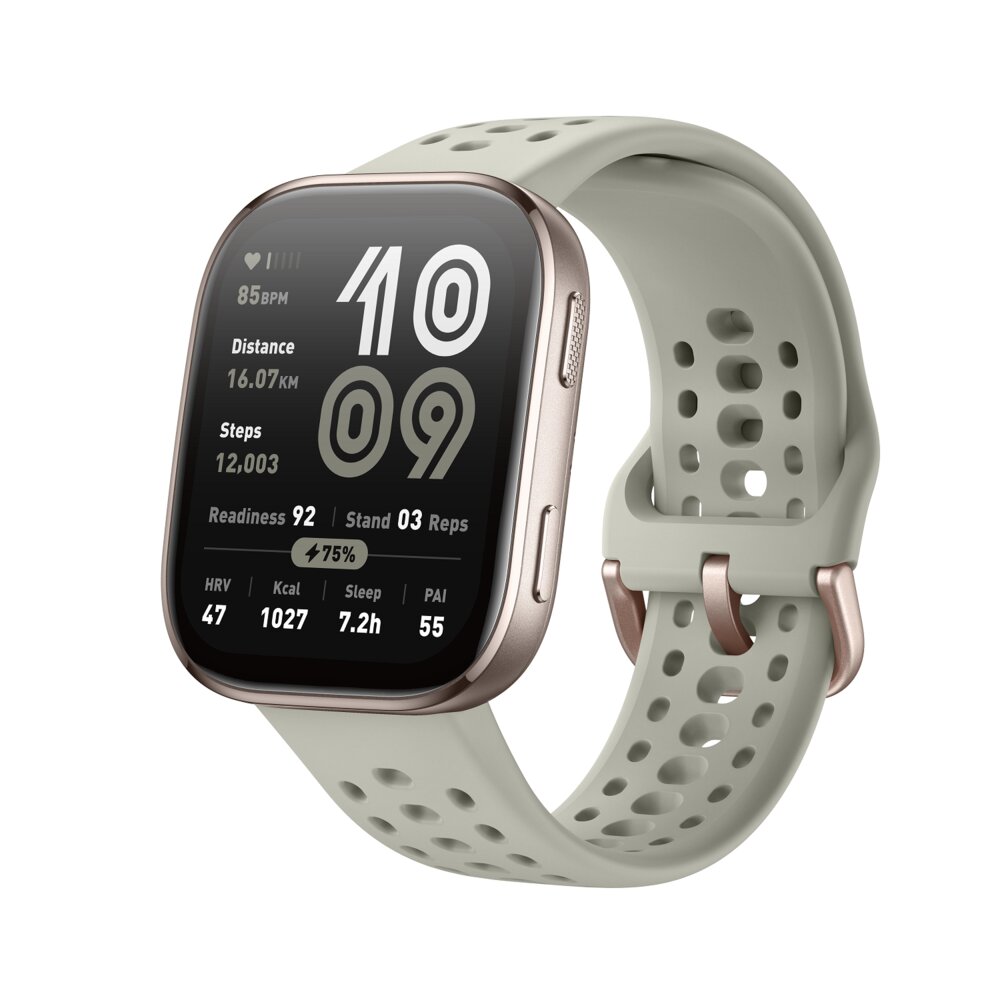
Some watches get dismissed before they earn a fair read. The Amazfit Bip 6, with its $79.99 price and a 14-day battery promise, looks like one of them, until you start matching the spec sheet against watches at two or three times the price in the same category. Then it starts to make sense.
Bip 6 is the entry tier of Amazfit's Zepp OS line, aimed at people who want continuous health, sleep and stress monitoring without paying flagship money. It is not built to impress at a triathlon, and it is not built to convince a cardiologist. What it is, on closer look, is one of the most honest budget propositions in the daily-wear category right now.
The hardware in numbers
Specs come straight from amazfit.com, verified 2026-05-25:
- Display: 1.97-inch AMOLED, 390 × 450 px, 302 PPI
- Battery: up to 14 days typical use, 26 days in saver mode
- GPS: 5 satellite positioning systems
- Water resistance: 5 ATM (swim-proof, not dive-rated)
- Weight: 27.9 g without strap
- Sport modes: 140+
- Sensors: BioTracker PPG heart rate, SpO2, continuous stress monitoring
- Price: $79.99 USD direct from Amazfit US
For context, the vast majority of watches with a comparable feature set (AMOLED display, multi-system GPS, continuous stress monitoring) sit at two to three times this price. The Bip 6 puts that whole package on the wrist for under a hundred dollars.
The full capability sheet, signal by signal, sits on the Amazfit Bip 6 device page, where the same 33 health signals are scored for every one of the 117 devices in the catalog.
What it does well
Three things stand out at this price.
The first is continuous stress monitoring. Most competitors keep it locked to flagship models. The Bip 6 includes it by default, using the BioTracker PPG sensor to derive a Zepp-proprietary stress score throughout the day. The number itself is opaque (Zepp does not publish the formula), but the trend over a week is informative, you see when sleep debt or work pressure pushes the line up, and you see it on a watch under a hundred dollars.
The second is battery life on an AMOLED display. Fourteen days of typical use is a number flagship watches still struggle to match, and Bip 6 reaches it without dimming the bright 1.97-inch panel. Any Wear OS watch (Pixel Watch, Galaxy Watch) needs a nightly charger; Bip 6 stays on your wrist through a full sleep-tracking cycle, then a holiday, without missing a night.
The third is the AMOLED itself at this price bracket. Most $80 watches ship dim LCD panels that look tired in sunlight. The Bip 6 ships an AMOLED that holds its own outdoors. It is not flagship-grade (peak brightness lags Apple Watch and high-end Garmin) but it is genuinely good for the price.
Where it gives ground
The trade-offs are clear, and worth knowing before you buy.
The Bip 6 does not do ECG, which means no AFib screening at the wrist. That is reserved for higher Amazfit tiers (Cheetah Pro and Helio) and for selected Fitbit and Apple Watch models. If atrial fibrillation runs in your family, or your doctor has asked you to track rhythm, look elsewhere.
It does not read skin temperature, the overnight version of which has become a quietly important signal for cycle tracking and pre-illness detection. Oura, Withings ScanWatch, Garmin Venu 3 and newer Fitbit hardware all include it. Bip 6 does not, full stop.
And the wrist-optical HRV is fine for daily trend monitoring (it gives you a number, that number roughly tracks your sleep quality, and over months it builds a personal baseline) but it is not chest-strap-grade. If you train at race intensity and use HRV to plan recovery between hard sessions, you want a Polar H10 or a similar chest strap, not a watch. See Polar vs Fitbit for that comparison.
Who it is for
The Bip 6 makes sense for a specific reader: somebody who wants a watch on the wrist day in and day out, who cares about long-term sleep and stress patterns, and who does not want to spend flagship money or learn flagship menus. People who train casually (running a few times a week, the occasional bike, a swim) get most of what they need from the GPS and the 140-plus workout modes. People who care about how their stress varies across a deadline-heavy week get a continuous number they did not have before.
It is the wrong watch if cardiac monitoring is the point, ECG and AFib screening live one tier up. It is the wrong watch if you race and plan training by HRV, buy a chest strap and a cheap watch that talks to it. And it is the wrong watch if you already own something above the entry-tier line; Bip 6 is not an upgrade, it is a sensible entry point.
If you are torn between budget brands, the matrix in Amazfit vs Fitbit lays out the trade-offs side by side, and Amazfit vs COROS does the same for the multi-week-battery niche.
A note on MyBodyAI integration
For full transparency, since this is published on the Aiclysm site: MyBodyAI does not yet read data from Zepp / Amazfit watches. It reads Fitbit, Oura, Polar and Withings after you log in, and Garmin through the Android app or a data export. The Zepp provider contract is declared in the codebase and the signal mapping is wired, but Open Platform developer access has not been granted, my request to developer@zepp.com from 2026-04-15 is still unanswered. I will update this post when the integration ships. Nothing in the review above depends on it.
Where to buy
Direct from Amazfit's US store. The link below is a plain vendor link. The CJ affiliate program this post used to run through ended in June 2026, so nothing here earns a commission, and the recommendation above never depended on one.
Frequently asked questions
Does the Amazfit Bip 6 have ECG?
No. The Bip 6 records no ECG and does no AFib screening at the wrist. It tracks heart rate, HRV, blood oxygen, respiratory rate, sleep stages and an all-day stress score. ECG starts one tier up in the Amazfit range (Cheetah Pro, Helio) and on selected Fitbit and Withings models.
How long does the Amazfit Bip 6 battery really last?
Amazfit quotes 14 days of typical use from the 340 mAh cell and 26 days in saver mode. Heavy use lands closer to 6 days, and continuous GPS runs up to 32 hours. An always-on display shortens all three figures.
Does the Bip 6 measure HRV and stress?
Both, from the wrist optical sensor. HRV is good enough for a personal trend but not chest-strap grade, so it will not replace a Polar H10 for planning hard sessions. The stress number is a proprietary Zepp score computed through the day; Zepp does not publish the formula, so read the weekly shape rather than the single value.
What does the Bip 6 not measure?
No ECG, no AFib detection, no skin temperature and no blood pressure. Skin temperature is the notable gap: its overnight version drives cycle tracking and early illness signals on Oura, Withings ScanWatch, Garmin Venu 3 and newer Fitbit hardware.
How much does the Amazfit Bip 6 cost?
$79.99 on the Amazfit US store across all five colourways, checked on 2026-08-07. That is roughly 1,700 CZK before local taxes and shipping.
Does the Amazfit Bip 6 work with MyBodyAI?
Not yet. MyBodyAI reads Fitbit, Oura, Polar and Withings after you log in, and Garmin through the Android app or a data export. Zepp, the platform behind Amazfit, has not granted developer access, so there is nothing to connect today.
Found this useful? Share it.