
Garmin and Oura together: how to combine two wearables without mixing up their numbers
A watch by day and a ring at night is a common pair. Here is why their numbers disagree, what goes wrong when an app simply merges them, and what to look for instead.
Why two devices give two different numbers
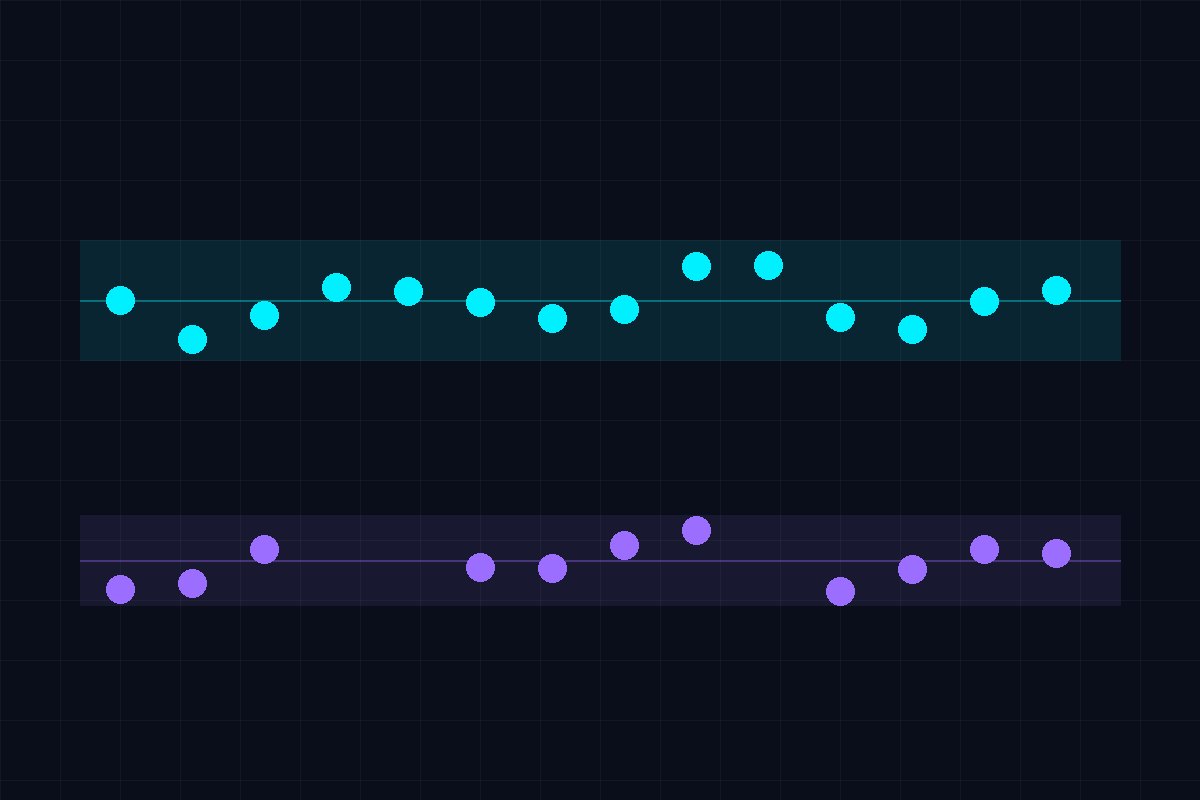
A ring reads the pulse in your finger, a watch on your wrist, a chest strap from the heart's electrical signal. Each brand also picks its own moment: some average HRV across the whole night, others use a window of deep sleep or the last part of the night. On the same night, the two numbers can sit several milliseconds apart, and both can be right on their own scale. Our HRV accuracy comparison goes through the brands in detail.
That is why HRV research reads a number against the same person's own recent values, not against a population table or another device (Plews et al. 2013; Vesterinen et al. 2016). A 48 ms night means something only next to that device's own usual nights.
What goes wrong when an app merges two devices
- Nights from two scales in one baseline. If the ring wins most nights and the watch fills in when the ring is charging, a baseline that mixes them swings with whichever device happened to be worn. Your recovery score then saw-tooths for no reason in your body.
- Steps counted twice. A walk recorded by both the watch and the phone is still one walk. Adding them up invents a day you did not have.
- Numbers that change source silently. If you cannot see which device a value came from, a jump can be a device swap rather than a change in you.
What to look for instead
- One source per signal, chosen by which device measures it better (often the ring for nights, the watch for workouts and daytime heart rate).
- A separate normal for each device, so a night from the backup device is judged against that device's own past nights.
- Choosing between devices, never summing them.
- The source named next to every value.
How MyBodyAI combines two wearables
- Signal by signal. Connect a watch and a ring and you do not have to pick a winner: nights can come from the ring while training, daytime heart rate and steps come from the watch.
- Each device on its own normal. When your main device misses a night and the other one covers it, that night's HRV is compared with the backup device's own nights, not with the main device's scale.
- The second device as a check. If both devices measured your week, the HRV card says in one sentence whether the second device confirms where your HRV sits against its own normal.
- Resting heart rate from the device that recorded the night, not from whichever device happened to sync last.
- Never added up. Two devices are only chosen between. Each number keeps the name of the device it came from.
Connections: Polar, Withings, Oura, COROS and Garmin by login; Fitbit and Pixel Watch through Google Health; any app that writes into Android Health Connect. A Garmin data export can add older history. MyBodyAI runs on the web and on Android.
Other options
Apple Health on iPhone and Health Connect on Android store data from many devices side by side, and many apps read from them. They are storage first: comparing two devices against their own history is left to you or to the app that reads the data. If you only ever wear one device, its own app already reads it against its own history, and a second app adds less.
References
- Plews DJ, Laursen PB, Stanley J, Kilding AE, Buchheit M (2013). Training adaptation and heart rate variability in elite endurance athletes: opening the door to effective monitoring. Sports Medicine, 43(9), 773 to 781.
- Vesterinen V, Nummela A, Heikura I et al. (2016). Individual endurance training prescription with heart rate variability. Medicine & Science in Sports & Exercise, 48(7), 1347 to 1354.
Frequently asked questions
I wear a Garmin and an Oura ring. Which one does MyBodyAI use?
Both, signal by signal. Nights can come from the ring while training, daytime heart rate and steps come from the watch. Every number keeps the name of the device it came from.
Why do my watch and my ring show different HRV?
They measure in different places (wrist, finger), at different moments of the night and with different algorithms. Both can be right on their own scale, which is why each device should be read against its own past nights, not against the other device.
Will my steps be counted twice?
No. MyBodyAI never adds two devices together; it chooses one source per signal, so a walk recorded by the watch and the phone stays one walk.
What happens on a night I did not wear my main device?
If the other device recorded it, that night's HRV is compared with the other device's own nights, so the change of device is not read as a change in your HRV.
Found this useful? Share it.