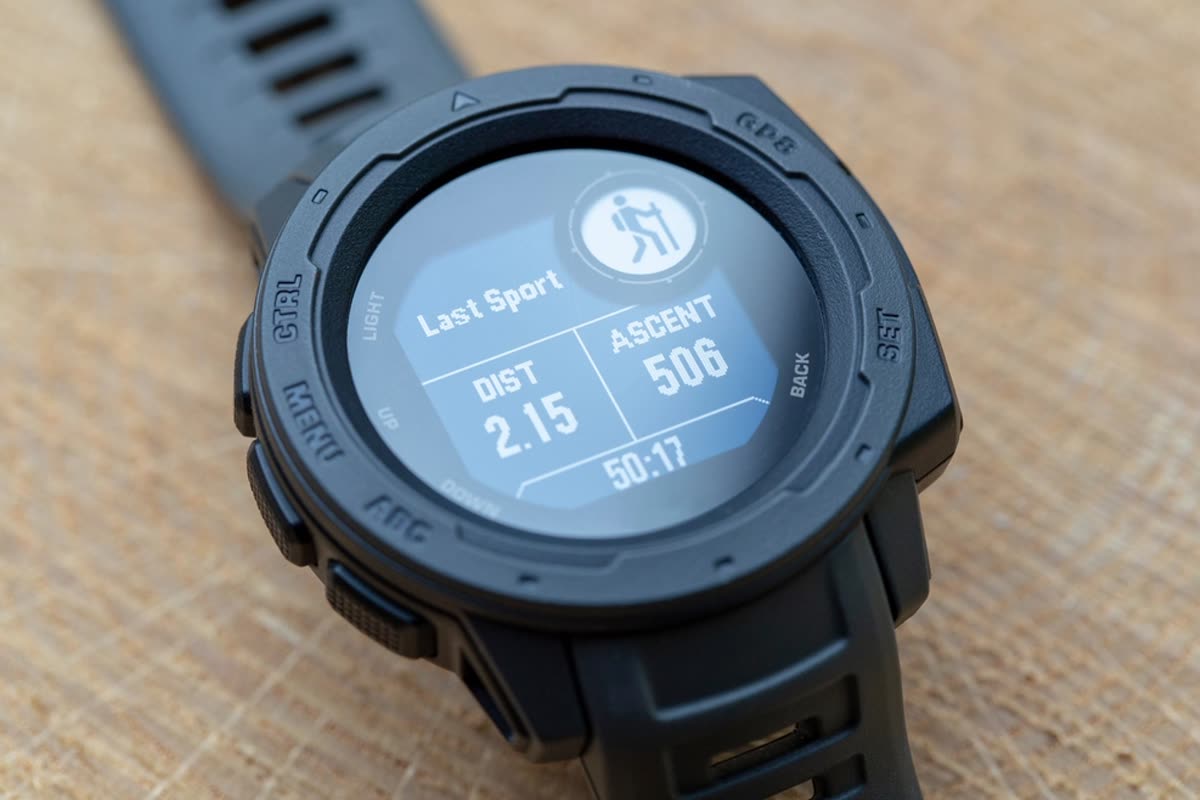
Above: an outdoor watch with a memory-in-pixel display, the screen technology that survives on the fenix 9 Pro Solar. The photograph is CC0 and shows a different Garmin.
Garmin put the fenix 9 and the fenix 9 Pro on sale on 25 August 2026. Two lines, three case sizes each, four variants at the top, and a price list that runs from 999.99 to 1,399.99 USD. This is a review of what that money buys, built from Garmin's own specifications, the published spec sheets and our device catalogue, with the outgoing fenix 8 and the current competition in the same frame.
One thing up front, because it decides how you should read the rest: we have not worn these watches. Nobody outside Garmin has worn them long enough to publish measured battery or heart rate accuracy yet. Everything below is specification, price and comparison, and the section on what we could not check says exactly where that stops being enough.
The fenix 9 is a screen, storage and navigation upgrade on an unchanged sensor set. Every health measurement it takes, the fenix 8 already took, with the same optical sensor, the same ECG electrodes, the same Pulse Ox and the same skin temperature reading. If your reason for buying is the data, the generation number is not the thing to pay for.
- Brightest fenix screen so far, up to 3,000 nits on the Pro
- 64 GB, twice the fenix 8, with 50 percent more RAM and faster map panning
- Sapphire lens and a titanium bezel on the base model, full titanium on the Pro
- Satellite messaging offered in all three Pro sizes, not just the largest
- Same launch price as the fenix 8 at the same size
- No new sensor and no new measurement anywhere in the range
- The base fenix 9 has a polymer case and no solar option at any size
- Satellite at a like-for-like size and screen costs 100 USD more than it did on the fenix 8 Pro
- Power modes were renamed, which makes the activity hours hard to compare against the fenix 8
- Battery and accuracy figures are Garmin's own, with no independent measurement behind them yet
What Garmin actually shipped
Two lines, three case sizes each. The plain fenix 9 comes in 43, 47 and 51 mm with an AMOLED screen and no solar option at all, from 999.99 USD. The fenix 9 Pro sits above it from 1,099.99 USD, in the same three sizes, and it is the one that keeps a choice of screen: AMOLED at up to 3,000 nits, or a memory-in-pixel panel with solar charging in the 47 and 51 mm cases.
- The Pro is the first fenix with a full titanium case. The standard fenix 9 uses fibre-reinforced polymer with a titanium rear cover and a titanium bezel.
- inReach satellite messaging and LTE are a separate Pro variant, offered in all three Pro sizes rather than only at the top.
- 64 GB of storage, twice the fenix 8, and 50 percent more RAM. Garmin quotes twice as many downloaded maps, room for 7,000 songs and 30 percent faster map panning.
- Sapphire glass on both lines, 10 ATM water resistance and a 40 m dive rating to EN13319.
- New in software: Garmin Epic, which groups several activities into one shareable story, stamina zones and a stamina curve, rucking with pack weights up to 100 kg, indoor rowing with VO2max and a power curve, a perspective view for navigation, Garmin Locate, and satellite or LTE weather on the connected models.
Read that list again and notice what is not in it. There is no new sensor on the back of the watch, and no measurement the fenix 8 could not already take.
The line-up, size by size and price by price
Nine variants ship under two names, and the price ladder does not run the way case sizes usually do. Launch prices, US list, from Garmin and the published spec sheets.
| Variant | Screen | 43 mm | 47 mm | 51 mm |
|---|---|---|---|---|
| fenix 9 | AMOLED | 999.99 | 999.99 | 1,099.99 |
| fenix 9 Pro | AMOLED | 1,099.99 | 1,099.99 | 1,199.99 |
| fenix 9 Pro Solar | memory-in-pixel | not offered | 1,099.99 | 1,199.99 |
| fenix 9 Pro inReach | AMOLED | 1,349.99 | 1,299.99 | 1,399.99 |
| fenix 9 Pro Solar inReach | memory-in-pixel | not offered | 1,199.99 | 1,299.99 |
US list price at launch, in dollars. European list prices carry the same figures in euros; UK prices run 859.99 to 1,209.99 GBP.
Two things in that table are worth saying out loud. The first is that the 43 mm inReach at 1,349.99 USD costs 50 USD more than the 47 mm at 1,299.99. The smaller watch is the dearer one, which is the opposite of how a size ladder normally runs, and it makes the 43 mm satellite model the odd purchase of the range unless a small wrist rules the others out.
The second is that the cheapest way into satellite messaging is the 47 mm Pro Solar inReach at 1,199.99 USD, on the memory-in-pixel screen. That is the same price the fenix 8 Pro asked in 2025 with inReach built in, but the fenix 8 Pro gave you an AMOLED for it. Matched on size and screen, the fenix 9 Pro AMOLED inReach is 1,299.99 USD, so satellite on a bright screen went up by 100 USD even though the Pro tier itself came down by the same amount.
Screen: the choice the range makes for you
A memory-in-pixel panel holds its image without redrawing it, so it sips power and is at its best in direct sun. Indoors it looks dim and the colours are flat. AMOLED is bright, sharp and readable in a dark room, and it eats battery, particularly with the display always on. This is the one hardware decision in the range that changes how the watch behaves day to day.
Garmin has narrowed who gets to make it. The base fenix 9 is AMOLED only, at every size. Memory-in-pixel now exists solely on the Pro, and only in 47 and 51 mm, so a 43 mm wrist has no long-battery option at all.
- fenix 9, 43 mm: 33 mm panel, 416 by 416 pixels, 20 mm QuickFit band.
- fenix 9, 47 mm: 35.56 mm panel, 454 by 454, 22 mm band. Garmin describes the base AMOLED as twice as bright as the fenix 8.
- fenix 9 Pro, 47 mm AMOLED: 35.6 mm, 454 by 454, up to 3,000 nits.
- fenix 9 Pro, 51 mm AMOLED: 38.1 mm, 466 by 466. Garmin's first 1.5 inch fenix display and 15 percent more display area than the fenix 8.
- fenix 9 Pro Solar: memory-in-pixel at 260 by 260 in the 47 mm case, 280 by 280 in the 51 mm, under a Power Sapphire lens.
Sapphire is standard across both fenix 9 lines, so the glass is no longer what tells the tiers apart. On the 47 mm AMOLED, panel size and resolution are unchanged from the fenix 8: 35.56 mm and 454 by 454 in both generations. The brightness claim is the change, and brightness is the one screen specification nobody outside Garmin has measured yet.
Battery: read the mode names before the numbers
Garmin renamed the activity modes between generations. The fenix 8 quotes GPS Only, All Systems and All Systems plus Multi-band. The fenix 9 quotes Normal, Extended, Max Battery and Max Accuracy. Garmin has never published which old mode corresponds to which new one, so putting 47 hours next to 30 hours produces a drop that nobody measured.
Two mode names did survive the rename, and they are the only honest like-for-like rows in the whole comparison:
- Max Battery: 81 hours on the fenix 8, 81 hours on the fenix 9. Identical.
- Expedition: 17 days on the fenix 8, 18 days on the fenix 9.
- Smartwatch mode: 16 days on both, at 47 mm.
In other words, wherever the two generations use the same word for the same thing, almost nothing moved. The rest of the difference is a naming difference, and it should be read as one.
Within the fenix 9 range the numbers do separate, and this is where the screen choice pays off. All figures 47 mm, Garmin's own.
| 47 mm | fenix 9 | 9 Pro AMOLED | 9 Pro Solar | 9 Pro Solar, in sun |
|---|---|---|---|---|
| Smartwatch | 16 d | 18 d | 21 d | 34 d |
| Activity, Normal | 30 h | 32 h | 54 h | 81 h |
| Max Accuracy | 25 h | 26 h | 38 h | 49 h |
| Max Battery | 81 h | 87 h | 132 h | 740 h |
| Expedition | 18 d | 18 d | 38 d | 68 d |
Garmin's published figures, 47 mm cases. The last column is Garmin's with-sun figure for the Solar; the column before it is the same watch without sun.
The headline solar number Garmin puts on posters, 57 days, belongs to the 51 mm Pro Solar and is a with-sun figure. The same watch is quoted at 30 days without it, one day short of the 51 mm AMOLED Pro at 31 days. Sunlight, not the panel, is doing the work in that comparison. In the activity modes the memory-in-pixel screen wins outright even indoors: 54 hours against 32 in Normal at 47 mm, before any sun at all.
Build, materials and durability
The Pro is the first fenix with a full titanium case. That is a genuine material upgrade and it costs weight: 78 g for the 47 mm Pro AMOLED against 75 g for the base fenix 9 and 73 g for a titanium fenix 8 at the same size. The 51 mm Pro AMOLED is 99 g, and the 51 mm Pro Solar is 102 g, which is a lot of watch for a slim wrist to carry overnight, and overnight is when the health data is collected.
- fenix 9: fibre-reinforced polymer case, titanium bezel, titanium rear cover, sapphire lens. 61 g at 43 mm, 75 g at 47 mm, 91 g at 51 mm, straps included.
- fenix 9 Pro: full titanium case and bezel, sapphire lens, Power Sapphire on the Solar. 62 g at 43 mm, 78 g at 47 mm, 99 g at 51 mm.
- Both lines: 10 ATM, dive rated to 40 m under EN13319, MIL-STD-810 compliance, QuickFit bands at 20, 22 and 26 mm by size.
One caveat on that comparison: the fenix 8 was not a metal watch either. It used the same fibre-reinforced polymer construction, with a bezel you could have in stainless steel or titanium, at 73 g and 80 g respectively. The fenix 9 fixes the bezel at titanium, which removes the heavier stainless option, and still comes out 2 g above the titanium fenix 8 at the same size. The Pro is the only one in the range where the case itself is metal.
Health sensors: what it measures, and what it does not
This is the part of the review where a new generation usually earns its number, and this one does not. Garmin's Elevate Gen 5 optical sensor, the ECG electrodes, the Pulse Ox and the skin temperature sensor all carry over from the fenix 8 without a change. A signal is produced by a sensor, not by a model number.
Our catalogue tracks 33 health signals across 113 devices. Here is every one of them, drawn once per watch. A filled cell is a signal the watch records.
Four watches, two generations, one flagship tier above each, and the same 21 signals out of 33 in all four rows. The strips are identical because the hardware behind them is.
What a fenix 9 measures: resting heart rate and HRV, blood oxygen, respiratory rate, skin temperature, a single-lead ECG with AFib screening, sleep duration, stages and a sleep score, steps, distance, floors, active minutes and calories, VO2max, training load, recovery and readiness, Body Battery and continuous stress.
What it does not, and why it never will: weight, body fat, muscle and bone mass, visceral fat, hydration and blood pressure. Those need a scale or a cuff, not a wrist. Waiting for a future fenix to add them is waiting for the wrong device. The two gaps that a watch genuinely could close one day are a validated apnea index and a cuffless blood pressure reading, and neither arrived here.
One caveat on the ECG: Garmin's ECG app is cleared market by market, so whether it is available to you depends on where the watch is sold, not on the hardware.
Sport, GPS and navigation
Positioning is multi-band dual-frequency across GPS, GLONASS, Galileo, QZSS and BeiDou, with SatIQ picking the mode. That is the fenix 8 arrangement carried forward. The change is what happens after the fix: 64 GB of storage against 32 GB, 50 percent more RAM, and a claimed 30 percent faster map panning, which on a mapping watch is the difference between a map you use mid-run and one you wait for.
The software additions are real but incremental. Stamina zones and a stamina curve extend the existing stamina model. Rucking now takes pack weights up to 100 kg. Indoor rowing gains VO2max and a power curve. Navigation gains a perspective view. Garmin Epic bundles several activities into one shareable story, and Garmin Locate helps find a misplaced watch. On the connected models, LiveTrack runs over LTE and weather forecasts arrive by satellite.
None of this changes what the watch records about your body. It changes what it does with your route and your session, which for a mountain or ultra user is the more relevant half of the device.
fenix 9 against fenix 8: is the upgrade worth it?
Four watches, all in the 47 mm AMOLED version so the comparison is like for like. Every figure below is generated from our device catalogue rather than typed, so it cannot drift away from the rest of the site. Both new watches have a page of their own there: the fenix 9 and the fenix 9 Pro.
| fenix 8 | fenix 8 Pro | fenix 9 | fenix 9 Pro | |
|---|---|---|---|---|
| Released | 2024 | 2025 | 2026 | 2026 |
| Launch price | 999 USD | 1,199 USD | 999 USD | 1,099 USD |
| Battery, smartwatch | 16 d | 15 d | 16 d | 18 d |
| Weight | 73 g | 77 g | 75 g | 78 g |
| Satellite and LTE in this version | no | yes | no | no |
| Health signals read | 21/33 | 21/33 | 21/33 | 21/33 |
All four in the 47 mm AMOLED version. Generated from the device catalogue.
If you own a fenix 8 and bought it for the data, there is no case for the upgrade. Same signals, same battery in the modes that share a name, same launch price at the same size. What you would be paying for is a brighter screen, double the storage and faster maps. Worth having, not worth 999 USD on top of a watch that already works.
If you own a fenix 8 Pro, the case is weaker still. Your watch has inReach built in at a price the fenix 9 now charges extra for on the same screen.
If you are buying your first serious multisport watch, the fenix 9 is a sound choice, and so is a discounted fenix 8. The outgoing generation measures exactly what the new one measures, and outgoing generations are where the discounts land. Which of the two is better value depends entirely on the price you can find, not on the specification.
How it compares outside Garmin
Garmin is not the only company selling an outdoor watch at this level, and on the health side it is not automatically the leader either. Signal counts below are from the same 33-signal catalogue, so they are comparable with the strip above.
| Watch | Launch price | Signals | Smartwatch battery |
|---|---|---|---|
| Garmin fenix 9 | 999 USD | 21/33 | 16 d |
| Garmin fenix 8 Pro | 1,199 USD | 21/33 | 15 d |
| Polar Grit X2 Pro | 999 USD | 18/33 | 10 d |
| COROS VERTIX 2S | 699 USD | 14/33 | 40 d |
| Suunto Vertical 2 | 599 USD | 13/33 | 20 d |
| Amazfit T-Rex Ultra 2 | 549 USD | 18/33 | 30 d |
Launch prices and manufacturer battery figures from our catalogue. Battery is smartwatch mode, which is the only mode every brand names the same way.
Read down the signal column and the fenix 9 leads, but not by the margin its price implies. The COROS runs two and a half times longer on a charge for 300 USD less and gives up seven signals to do it. The Amazfit reaches 18 of 33 at a bit over half the price. What Garmin sells at 999 USD that the others do not is the combination: a full signal set, mapping, multi-band positioning and, on the Pro, satellite messaging in one device.
Which one to buy
Assuming you have decided on this range, the variant matters more than the generation.
- Bright screen, no satellite, lowest price: the base fenix 9 at 999.99 USD. Polymer case, no solar, everything else intact.
- Longest battery: the 51 mm Pro Solar. Its advantage over AMOLED is real in activity modes and only decisive in smartwatch mode if you spend hours a day outdoors.
- Satellite messaging, cheapest route: the 47 mm Pro Solar inReach at 1,199.99 USD, if you can live with the memory-in-pixel screen.
- Satellite on a bright screen: the 47 mm Pro AMOLED inReach at 1,299.99 USD. Skip the 43 mm version unless a small wrist requires it, because it costs 50 USD more for less watch.
- Buying for health data alone: a discounted fenix 8, or the watch already on your wrist. The measurements are the same.
One running cost that is easy to miss: the inReach satellite and LTE features need a paid Garmin plan on top of the hardware. Health tracking and Garmin Connect stay free, which is not true of every brand in the table above.
What we checked, and what we could not
This review is built from specifications, prices and a signal-by-signal catalogue, not from time on the wrist. That distinction matters for three claims in particular, and we would rather name them than let them pass as tested.
- Battery figures are Garmin's own. No independent measurement of the fenix 9 exists yet. Garmin's numbers have historically been reachable but optimistic, and one hands-on review of the fenix 8 Pro measured lower than the official figure.
- Heart rate and HRV accuracy is untested here. The sensor is carried over from the fenix 8, so the fenix 8 evidence should apply, but that is an inference and not a measurement of this watch.
- Brightness, panel quality and how the maps feel in the hand need the device. Garmin's 3,000 nit and 30 percent figures are unverified claims until someone measures them.
What we can stand behind: the specification comparison, the price ladder, and the signal strip, which is generated from the catalogue every time the catalogue changes rather than typed into the article.
Sources
Announcement and specifications: Garmin's own press release of 25 August 2026, the battery tables in Garmin's fenix 9 series owner's manual, and the published specification sheets for the fenix 9, the fenix 9 Pro and the fenix 8, including their launch price tables. Signal counts, catalogue prices, weights and battery figures come from our device catalogue, built from manufacturer specification sheets and cross-checked against independent hands-on reviews; the comparison table and the signal strip on this page are generated from it rather than typed. Battery figures for the fenix 9 and fenix 9 Pro are Garmin's official ones and have no independent measurement behind them yet.
Photograph: the image in this article is CC0 and shows a different device.
Disclosure: this site is published by Aiclysm, which also makes MyBodyAI, a health analytics app that reads data from several wearable brands including Garmin. Nothing on this page is an affiliate link and no manufacturer supplied a review unit, because there was no review unit. A note on what the fenix 9 means for MyBodyAI users follows below, kept separate from the review on purpose.
Note for MyBodyAI users
Nothing changes. A fenix 9 lands in exactly the same place a fenix 8 does: same signals, same quality tiers, same scores. What we can read from a Garmin is decided by how Garmin lets data out, not by which Garmin you wear, and Garmin has no official health API, so every Garmin account arrives through a data export file. If you were hoping the new watch would unlock something in the app, it will not.
Frequently asked questions
Is the Garmin fenix 9 worth upgrading to from a fenix 8?
Not if you bought the fenix 8 for the data. The fenix 9 uses the same Elevate Gen 5 optical sensor, the same ECG electrodes, the same Pulse Ox and the same skin temperature sensor, so it records the same 21 health signals out of the 33 our catalogue tracks. The upgrade buys a brighter screen, 64 GB instead of 32 GB, more RAM and faster map panning. In the two battery modes both generations name the same way, Max Battery and Expedition, the figures are 81 hours against 81 hours and 17 days against 18 days.
What is the difference between the fenix 9 and the fenix 9 Pro?
Case material, screen brightness and the options above them. The Pro has a full titanium case against fibre-reinforced polymer with a titanium bezel and rear cover on the base model, an AMOLED rated up to 3,000 nits, and it is the only one of the two offered with a solar memory-in-pixel screen or with inReach satellite messaging. The health sensors, the positioning and the 64 GB of storage are identical. The Pro starts at 1,099.99 USD against 999.99 for the fenix 9.
How long does the Garmin fenix 9 battery last?
Garmin quotes 16 days in smartwatch mode and 30 hours in an activity at Normal power for the 47 mm fenix 9, 18 days and 32 hours for the 47 mm Pro AMOLED, and 21 days and 54 hours for the 47 mm Pro Solar before any sunlight. The headline 57 days belongs to the 51 mm Pro Solar and is a with-sun figure; the same watch is quoted at 30 days without sun. All of these are Garmin's own numbers and no independent measurement of the fenix 9 exists yet.
Does the fenix 9 have any new health sensors?
No. Garmin's announcement lists a brighter screen, a titanium case on the Pro, 64 GB of storage, faster maps and new software, and not one new sensor on the back of the watch. The fenix 9 measures resting heart rate, HRV, blood oxygen, respiratory rate, skin temperature, a single-lead ECG with AFib screening, sleep, training load, recovery, Body Battery and continuous stress, all of which the fenix 8 already measured. Weight, body fat, hydration and blood pressure need a scale or a cuff and no wrist watch in this class reads them.
Which fenix 9 has satellite messaging, and what does it cost?
inReach is a variant of the fenix 9 Pro and Garmin offers it in all three case sizes. The cheapest route is the 47 mm Pro Solar inReach at 1,199.99 USD on the memory-in-pixel screen. On AMOLED it is 1,299.99 for the 47 mm, 1,349.99 for the 43 mm and 1,399.99 for the 51 mm, so the smallest case is 50 USD dearer than the middle one. The satellite and LTE features also need a paid Garmin plan; health tracking and Garmin Connect stay free.
AMOLED or solar: which fenix 9 screen should I choose?
Solar is only on the fenix 9 Pro in 47 and 51 mm, so a 43 mm wrist has no choice to make. Where the choice exists, the memory-in-pixel panel wins clearly in activity modes, 54 hours against 32 at 47 mm before any sun, and it is at its best in bright daylight. AMOLED is sharper, far brighter and readable indoors and at night. If most of your hours are outdoors and long, take the solar; if the watch spends its day inside, take the AMOLED.
Found this useful? Share it.