
Can your wearable detect illness before you feel it?
Your immune system leaves measurable traces long before you reach for the tissues. Wearable sensors can read them.
The immune system leaves traces
Before you feel the first scratch in your throat, before the fatigue sets in, your body is already fighting. The immune system doesn't wait for conscious awareness, it mobilizes immediately, and that mobilization produces measurable physiological changes that modern wearable sensors can detect.
When your immune system activates against a pathogen, several things happen simultaneously. Your heart rate variability (HRV) drops as the sympathetic nervous system takes over. Your resting heart rate (RHR) rises because the body increases cardiac output to circulate immune cells. Skin temperature increases, often before a fever is detectable by traditional thermometers. Blood oxygen saturation (SpO2) may dip, especially with respiratory infections. And your sleep architecture changes, less time in deep and REM sleep, more awakenings, and altered sleep onset latency.
These changes aren't random noise. They form a recognizable pattern, one that wearable devices with optical heart rate sensors, accelerometers, and temperature sensors are increasingly able to capture.
The inflammatory reflex
In 2002, neurosurgeon Kevin Tracey published a groundbreaking paper describing the inflammatory reflex, a direct neural circuit through which the vagus nerve modulates the immune response (Tracey, 2002). This was a paradigm shift: the nervous system doesn't just passively observe inflammation, it actively regulates it.
The vagus nerve is the primary parasympathetic pathway, and its activity is directly reflected in HRV. Higher vagal tone means better immune regulation, the body can mount an appropriate inflammatory response and then shut it down efficiently. Conversely, low vagal tone (low HRV) correlates with reduced immune regulation, meaning the body is slower to contain inflammation and slower to recover from infection.
This is why HRV isn't just a fitness metric, it's a window into your immune competence. People with chronically low HRV don't just recover slower from workouts; they recover slower from infections too.
What the research shows
Pre-symptomatic COVID detection
Mishra et al. (2020), published in Nature Biomedical Engineering, analyzed smartwatch data from 32 people infected with COVID-19: 26 of them showed a change in heart rate, daily steps or time asleep, and a warning system built on resting heart rate rising above the person's own baseline would have flagged 63% of the cases before symptom onset, four of them at least nine days earlier.
Sensor data next to symptoms
Quer et al. (2021) enrolled 30,529 people who shared smartwatch and activity data through an app. Among those who developed symptoms, sensor data (resting heart rate, sleep, activity) added to the symptoms told COVID-19 positive from negative with an AUC of 0.80, against 0.71 for symptoms alone. At the population level, Radin et al. (2020) showed that resting heart rate and sleep from Fitbit users tracked state-level influenza-like illness better than the official reports alone.
Vagal tone and inflammation
Williams et al. (2019) pooled 51 studies and found that higher HRV, especially its vagal components, goes with lower inflammatory markers. That is the inflammatory reflex seen in data: the same nerve that raises HRV keeps inflammation in check, so a daily HRV reading says something about how well the body holds inflammation down.
5 biomarkers your wearable can track
Not all wearables measure all of these, but most modern wearables (Polar, Fitbit, Withings, Garmin) cover at least three:
1. Resting heart rate elevation
An increase of more than 5 bpm above your personal baseline, sustained over 24–48 hours, is one of the earliest and most reliable pre-illness signals. This reflects increased cardiac output as the body prepares to fight infection. Key: it must be compared to your baseline, not a population average.
2. HRV depression
A drop of more than 15% below your 7-day rolling average indicates significant autonomic stress. When this happens without an obvious cause (hard training, alcohol, poor sleep), immune activation should be considered. HRV is best measured during sleep for consistency. Check your trends with the HRV Decoder.
3. Sleep disruption
Watch for reduced deep sleep percentage, increased number of awakenings, and longer sleep onset latency. The immune system and sleep are deeply intertwined, pro-inflammatory cytokines alter sleep architecture even before you feel sick. If your deep sleep drops below 15% of total sleep time for 2+ consecutive nights without explanation, pay attention.
4. SpO2 dips
Blood oxygen levels below 95% during sleep can indicate early respiratory involvement. Many wearables now offer continuous overnight SpO2 monitoring. A single dip isn't concerning, but repeated desaturation events or a downward trend over 2–3 nights warrants attention. Track breathing patterns with the Respiratory Rate Calculator.
5. Skin temperature elevation
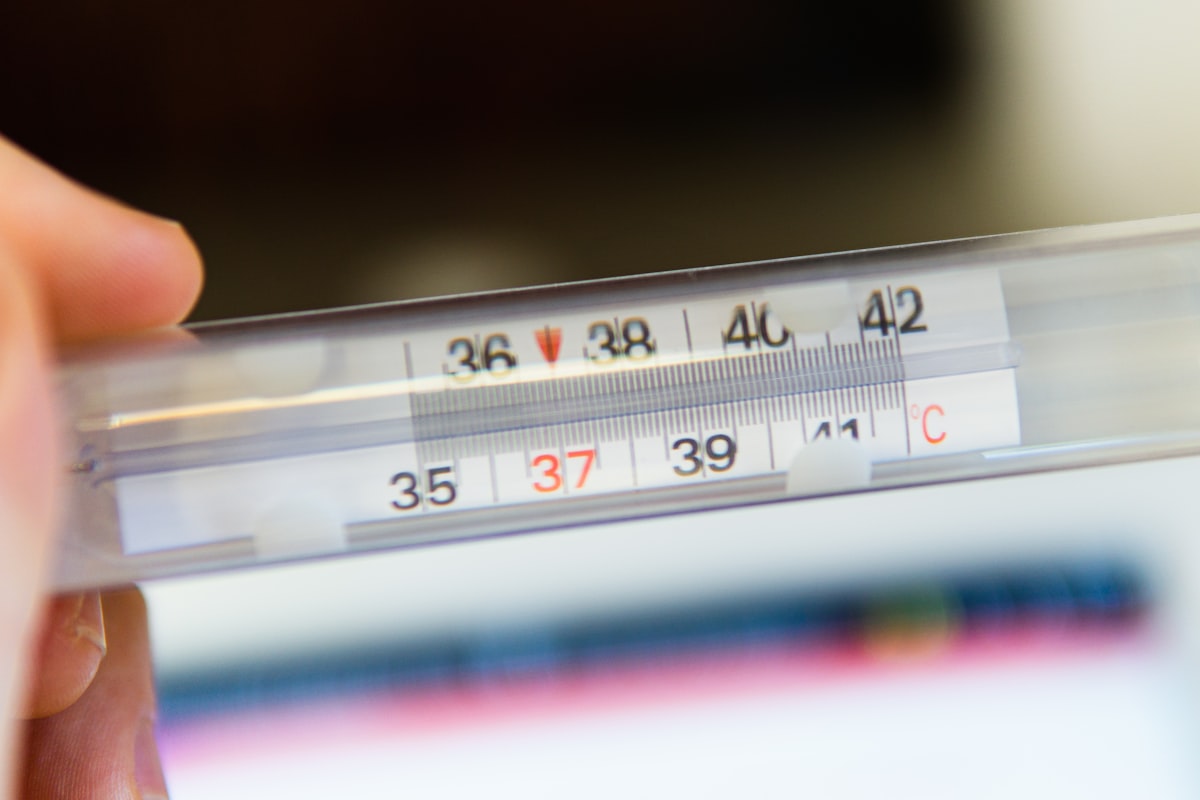
Devices like Garmin and Fitbit measure wrist skin temperature continuously. An increase of more than 0.5°C above your personal baseline is a sensitive indicator of immune activation, more sensitive than a forehead thermometer, because it captures the body's thermoregulatory shift before core temperature rises noticeably.
What to do when your wearable flags something
Seeing multiple biomarkers shift simultaneously doesn't mean you're definitely getting sick, but it means your body is under immunological stress. The appropriate response isn't panic; it's precaution:
- Reduce training intensity: drop to zone 1–2 or switch to light walking. Hard training during immune activation extends illness duration and increases severity. This is not the day for intervals.
- Prioritize sleep: aim for 8+ hours. Your immune system does its heaviest work during deep sleep. Go to bed earlier than usual if possible.
- Hydration: increase fluid intake. Immune cell trafficking depends on adequate hydration, and mucous membrane defense is impaired when dehydrated.
- Monitor for 48–72 hours: if signals normalize, your immune system likely handled the challenge. If they persist or worsen, consider reducing social exposure and consulting a physician.
Reading several signals at once
Most wearables show you individual metrics, a heart rate graph here, an HRV number there. The challenge is interpreting multiple signals simultaneously and separating illness signals from training load, alcohol, stress, or poor sleep.
The approach that works is simultaneous analysis of several signals: resting heart rate, HRV, sleep quality, respiratory rate and SpO2, each read against a personal baseline and cross-referenced with recent activity load. When several of them move together in a way that training and lifestyle do not explain, that is the point worth noticing.
Personal patterns take time to emerge. After several months of data, the shape that precedes an illness can be told apart from the one that follows a hard workout: both involve an elevated resting heart rate and depressed HRV, but the accompanying sleep and temperature patterns differ.
References
- Mishra, T., et al. (2020). Pre-symptomatic detection of COVID-19 from smartwatch data. Nature Biomedical Engineering, 4(12), 1208–1220.
- Quer, G., et al. (2021). Wearable sensor data and self-reported symptoms for COVID-19 detection. Nature Medicine, 27(1), 73–77.
- Radin, J. M., et al. (2020). Harnessing wearable device data to improve state-level real-time surveillance of influenza-like illness in the USA. The Lancet Digital Health, 2(2), e85–e93.
- Tracey, K. J. (2002). The inflammatory reflex. Nature, 420(6917), 853–859.
- Williams, D. P., et al. (2019). Heart rate variability and inflammation: A meta-analysis of human studies. Brain, Behavior, and Immunity, 80, 219–226.
Found this useful? Share it.